Climate change 'making seas more salty
Scientists report that increased salinity in oceans can be attributed to manmade climate change
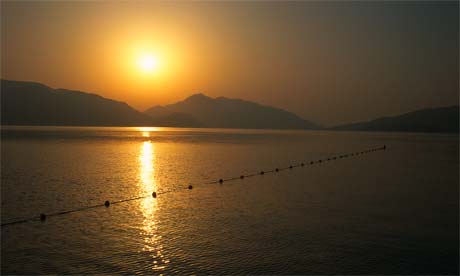
The Mediterranean area will become drier as a result of increased salinity in the water.
Global warming is making the sea more salty, according to new research that demonstrates the massive shifts in natural systems triggered by climate change.
Experts at the UK Met Office and Reading University say warmer temperatures over the Atlantic Ocean have significantly increased evaporation and reduced rainfall across a giant stretch of water from Africa to the Carribean in recent years. The change concentrates salt in the water left behind, and is predicted to make southern Europe and the Mediterranean much drier in future.
Peter Stott of the Met Office, who led the study, said: "With global warming we're talking about very big changes in the overall water cycle. This moisture is being evaporated and transported to higher latitudes."
The team wanted to see whether manmade climate change could be blamed for changes in salinity measured in the Atlantic. In 2003, experts reported that the north Atlantic waters were freshening, with salt levels decreasing – a mild version of the scenario depicted in the Hollywood film The Day After Tomorrow where massive amounts of fresh water shut down warm ocean currents and cause temperatures to plunge.
Meanwhile, further south towards the tropics, Atlantic waters have been getting saltier – about 0.5% more since the 1960s.
Using state-of-the-art climate models, the scientists simulated events over both parts of the ocean with and without increased levels of greenhouse gases. They found that the freshening of the north Atlantic could be explained by natural variations, a conclusion supported by a recent recovery of the salt levels there.
But for the mid Atlantic, the models showed that only human-driven global warming could explain the increase in saltiness – the first time such an explicit link has been made between climate change and salinity.http://www.guardian.co.uk/environment/2008/oct/27/climate-change-water
Because of climate change we have to face more natural dangerous than few years ago. Iam talking about more frequently storms, floods and hurricanes. I placed few links below reporting information about floods from 2007.
http://www.yorkshirepost.co.uk/news/Report-calls-for-34urgent34-review.3146391.jp
http://www.telegraph.co.uk/news/uknews/1556544/Hull-is-'forgotten-city'-of-the-flooding-crisis.html
http://www.ens-newswire.com/ens/jul2007/2007-07-24-03.asp
In conclusion, I believe it is connection between climate change raports and sustainable development. People are curious, want to know everything what is going around them, and basically want to improve their lifes, and in this case climate change is a big issue. From newspapers we can have a lot of information about it, see if things goes in good or bad way and try make them better.


